
Paper, which boosted the literary culture of China, silk, which drastically changed the economy and trade standing of China and surrounding civilizations, and gunpowder, which was invented by accident and quickly incorporated into weapons of war, were the most important inventions for the civilization of China and the inventions that changed the world the most.
Paper in invented in China in the 2nd Century by Cai Lun or Ts’ai Lun, an official in the Han court. According to legend, he was inspired by bees and wasps chewing up plant fibres to make their nests. Cai Lun presented papermaking to the Emperor He of the Han Dynasty, as an alternative to other costly and cumbersome mediums such as silk, bone, bamboo, and bark[i]. Cai Lun was revered then by the Emperor and later after his death by countless Chinese papermaking families. Before the invention of paper, not everyone was able to take part in literary culture which changed by paper providing an almost unlimited supply of convenient writing material and boosting China’s literary culture much faster than would have been possible through writing on bamboo and expensive silk. Majority of previous ancient literary works were recorded on paper and became readily available to the populace, and the holy books of the world religions could now also be printed down, and mass produced, boosted religious knowledge. It was easier to teach many pupils to read and write at one time and anyone with the knowledge could proceed to pursue this culture. Within 500 years, papermaking spread to Korea, Vietnam, and Japan, and after Arabs captured Chinese papermakers at the battle of the Talas river[ii], it spread all the way to Europe by the 12th century, properly changing the world.

- 1. Papermaking, http://www.chinesetimeschool.com/en-us/articles/the-four-great-inventions-of-ancient-china/3/ , retrieved October 17, 2018
One of the most sought-after items on the land and sea routes of the Silk road were what gave the roads their name: Silk. The technique of making silk was perfected in China thousands of years prior and China managed to keep these techniques for a millennium after opening trade with other civilizations, giving itself the global monopoly on silk. Chinese legends give Leizu, wife of the Yellow Emperor, credit for discovering the techniques to making silk, and for inventing the silk loom in the 27th century BCE[iii]. Silk was first confined to the use of the emperor and his immediate family and friends but eventually was available to the average citizen. Eventually, ancient civilizations started to trade through nomads and steppes people living beside them and goods spread all over the known world over the slowly established ‘silk’ roads, to places such as Egypt, Rome, and India, among places. The Roman empire temporarily banned silk because of the trade deficit caused by the interest in the cloth. Silk’s booming popularity caused many Chinese families to join the silk industry, and in spite of deep secrecy around the techniques, and death sentence for smugglers, the silk-making spread to surrounding countries and remained part of Asian culture ever since. The Silk roads are the perfect example of interaction between ancient civilizations and the spread of goods, ideas, technology, and religious ideas, and without the influence of the desert roads and ocean routes, the world would be radically different from what it is today.[iv]
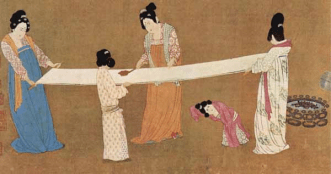
- 2. Silk Making, https://worldhistory.us/general/the-history-of-silk-production-silk-stands-the-test-of-time.php , retrieved October 17, 2018
Around 850 CE, Chinese alchemists inadvertently invented gunpowder while trying to discover the secret to immortality. Instead, they found a substance which was extremely flammable or explosive in right quantities, as was found when the scientists scarred by the flammable powder and their homes burned down[v]. The scientists considered it a failure, but gunpowder was incorporated into fireworks and signal rockets soon after it was invented. Though origins of gunpowder were nothing violent, military strategists soon found many uses for the flaming substance. Fire arrows and fire lances were the first of a revolutionary line of weapons, developed in the 10th to 12th centuries, which would eventually evolve and grow into the deadliest modern weapons we know of today. Fire lances were hollow tubes, first made of bamboo, filled with powder and projectile that were ignited to fire the projectiles at the enemy at very close range. These were later made of bronze. By the late 13th century, the Chinese had employed true guns which were cast of bronze or iron[vi]. Most of the newfound weapons were used to repel Mongol invasion, but working only temporarily, it fueled Mongol curiosity, and China was conquered by its own weapon. Arabs had spread the invention to the west by 1304, the Ottoman empire used cannons to take the city of Constantinople, and the West turned to firearms and gunpowder in the 14th century, radically changing the world. This artifact caused a wildfire of new technology to deal with outside dangers and dangers within themselves. Fear of danger and need to protect themselves, resulted in the adoption of an accidental invention to change the face of warfare forever and change society and history forever.

- 3. Gunpowder Rockets, http://fourriverscharter.org/projects/Inventions/pages/china_gunpowder.htm , Retrieved October 17, 2018
[i] Papermaking, Encyclopedia Britannica, https://www.britannica.com/technology/papermaking : Secondary Resource
Wilkinson, Endymion (2012), Chinese History: A New Manual, Harvard University Asia Center for the Harvard-Yenching Institute
[ii] Quraishi, Silim “A survey of the development of papermaking in Islamic Countries”, Bookbinder, 1989 (3): 29–36.
[iii] Lei Zu, The Amazing Bible Timeline with History, https://amazingbibletimeline.com/blog/leizu/
Chinese Empress Discovers Silk-Making, ThoughtCo., https://www.thoughtco.com/chinese-empress-discovers-silk-making-3529402
[iv] Silk Production and Trade in Medieval Times, ThoughtCo., https://www.thoughtco.com/silk-lustrous-fabric-1788616
[v] How Gunpowder Changed the World, LiveScience, https://www.livescience.com/7476-gunpowder-changed-world.html
[vi] Gunpowder| explosive, Encyclopedia Britannica, https://www.britannica.com/technology/gunpowder
Bibliography:
Papermaking, Encyclopedia Britannica, https://www.britannica.com/technology/papermaking : Secondary Resource
Wilkinson, Endymion (2012), Chinese History: A New Manual, Harvard University Asia Center for the Harvard-Yenching Institute
Quraishi, Silim “A survey of the development of papermaking in Islamic Countries”, Bookbinder, 1989 (3): 29–36.
Wikipedia, the History of Paper, https://en.wikipedia.org/wiki/History_of_paper
Wikipedia, Papermaking, https://en.wikipedia.org/wiki/Papermaking
Lei Zu, The Amazing Bible Timeline with History, https://amazingbibletimeline.com/blog/leizu/
Chinese Empress Discovers Silk-Making, ThoughtCo., https://www.thoughtco.com/chinese-empress-discovers-silk-making-3529402
Silk Production and Trade in Medieval Times, ThoughtCo., https://www.thoughtco.com/silk-lustrous-fabric-1788616
Gunpowder, Wikipedia, https://en.wikipedia.org/wiki/Gunpowder#History_of_gunpowder
Gunpowder| explosive, Encyclopedia Britannica, https://www.britannica.com/technology/gunpowder
How Gunpowder Changed the World, LiveScience, https://www.livescience.com/7476-gunpowder-changed-world.html
 Ancient History w/ Ibrahim Mallik